Rolling With the Punches On the Internet
I’ve gotten old enough that I’m tired of being defensive. It’s not that things don’t rile me up, but it’s not the way to go on the internet for endurance and for the distance.
Perhaps it is the inner /b/-tard inside of me, but I really enjoy the day of ROW ROW FIGHT THE POWER. And 90% of it is because the lot of them decided to drop by my blog yesterday as a part of some kind of meme chain. Has anyone else been affected?
I normally don’t (actually, pretty much never) browse any part of 4chan save for being linked to it from some online chat place, so after realizing something is up when a trickling stream of 4chan-esqe users leaving the same comments on the blog. A quick look in /b/ told me the rest.
I think as much people may be disgusted with 4chan, it’s really a good standard to gauge how ready you are to handle your stereotypical male, 18-34 demographic audience. It’s like learning how to deal with trolls who do so not out of vendetta but out of social engineering and “the lulz.”
Does that count as a part of this? More on that in a later post hopefully.
The common mistakes is to get hung up with what these guys may have already done. They may have staged an invasion to your domain on the internet; pushed you and your regular users out of your comfort zones; exposed you to obscene language and pictures; and generally cause disruption, logical ones and physical ones. Maybe they pissed you off and got under your skin.
But to react on that is to really, well, LOSE. It’s a true sign that you are really not any better than they are, even if in reality you have done nothing wrong. And the same principle applies to their teasing–it’s not about what you’ve done, it’s about what you’re going to do. Indeed, we do not live in the past, but the present.
Clearly the average /b/-tard doesn’t work on the same cause-effect patterns one would expect of people living in the real world. Yet the principle of causality still applies; the goal just to figure out which rules matters. You don’t have to play by their rules just because they don’t play with yours, but why be a stickler to rules when the whole point behind them is to engineer people’s behavior? It is more productive to simply understand and predict their behavior and act accordingly.
And usually by this stage, if you have realized this, you’ve already done all you needed to do.
I guess this is why there was this article today in the news. Clockshow needs more indie cred. Tagging it with Urotsukidoji should help amirite?
Mecha as Fig Leaves, Not as Genres
This post is a response to Daniel’s post on mecha as genre.
I think going down his line of abstraction is a little too much. I mean, yeah, once you boil it down a Gundam is just a projection of one’s earthly desires into heroism. Why does Superman fly? Why is Nono topless? The difference is perhaps one of idolatry versus escapist, self-insertion, and the boat floats either way you row your pickle.
But just because they both float, it doesn’t mean they are the same thing.
And I think it’s times like this we can really appreciate anime like Evangelion because it puts a face on a notion that the world has struggled with and responded (or rather, reacted to?) with great interest. It’s so very apt that Evangelion copied from Judeo-Christian and gnostic myths, because this is all very religious. And often times classic mecha anime have a sense of institution and formality to it that is not unlike some earthen religion or Hinduism.
Still, I think Daniel’s post paves the way to model the core components of a hero story. There are three core elements: the hero, the heorics, and the the audience. What makes a show tick is how the viewer relate and perceive the relationship between the hero and the heroics. What is unique about mecha from any other hero story–that separates BGC from Nanoha, let’s say–is the identity of this projection as we perceive it. What makes mecha anime different than others like it is that this projection has god-like attributes. And I don’t just mean in terms of physical powers, but also socially and in the psyche of our heroes (ie. they serve the same role as gods in the real world).
In other words, the hero is the heroics–you can’t have a mecha anime like that.
Would you pray to it? Many mecha heroes did. Some with tears, many with passionate screams, some speak the language and can reprogram really fast.
Some easy example of this are Evangelion and Neo Ranga. The mecha themselves serve not only as an extension of a will and desire for our heroes, but they are a pathway, a means, to achieve something beyond what powers might bring. In Neo Ranga’s case, it played the role from god to oracle to judge to house pet. In Eva’s case it’s not only man’s last defense, but also a road to total destruction of man…and a comfortable hole for an emo-head to hide in. It’s gooey, warm, and feels a lot like mom. Or in Xenoglossia’s case, the boyfriend you wish you had.
Everything before Eva can be seen as a road leading up to it. Is not Astroboy an embodiment of godhood in human society? Read much Shirow lately?
Gundam 00 played this up a notch with Setsuna’s complex, right? Silly teenage extremist. By the way I thought that was the most brilliant part of Gundam 00.
(Actually several Gundam series deal with this in a pretty amusing way. Such as when a mecha pilot put too much trust in the latest tech, only to be let down by the false god.)
What is god in the Nanoha universe? Sweat, blood, tears, lesbian undertonesnever-ending power of heart, and incremental upgrades of a deadly mix between tech and magic. Ancient prophecies, modern inventions and everything in between play a role. But none of it materializes as god. If anything, Nanoha is like Hercules; if there’s a claim to godhood, it would the worship of her (and not Raising Heart… If Daniel said Mai-Hime, however, he’d be right on). I always thought what was worshipped in the Nanoha series is a sense of ethics, of right and wrong.
Anyways, can we say the same thing about the Gurren-Lagann? Is that why the second half of the series was as hollow as it was?
And I think it gets into the divide between super robots and real robots?
And that is the difference between an age of darkness and an age of enlightenment. (Yes, yes, Mobile Suit Gundam brought upon the anime world an age of enlightenment; we all can agree on that I hope.) If we think of science and technology as the god of this age, it all makes sense? And what better symbol of modern technological advancement are there than made-in-Japan humanoid weapons? Well, maybe mutated giant tentacle monsters as an alternative (and they exist in mecha anime, even). The fiction of science went well with the fiction of god-idol-heroes; they’re peas in a pod.
What made the Evangelion so profound-seeming (to clarify my earlier point) is how it handled a duality of modern gods. Mankind has always understood deities to be both kind and cruel; but it wasn’t until the past few hundred years that we questioned their identity in an organized manner; are gods really gods? And with gods we can understand (eg. science & technology, even if it’s alien), we can make stories out of them that deal with this issue. Evangelion simply took that to a step beyond gods, to the ultimate creator of such gods–man himself. Evagelion did more than just took an axe to a tree, it took a lance and pierced the veil that separated imagination from our unconscious guilt.
Once we have understood construction of gods (as defined by real robots), we worship that faceless, personless understanding and no longer the personality which we now understand. The super robot magic is lost when this happens. In Gurren Lagann’s case, we have ourselves a real robot anime with the trapping of a super robot show (at about half way through the second arc), although by then we have a lot of pretty stuff on the screen to distract us. And will Nia be saved?
I believe the opposite perspective coincidentally, is held by Gunbuster–a proper, modern day miracle where science + heart overcomes obstacles size of stars. Of course, part of the ordeal within Gurren Lagann is one that does not have a textbook happy ending, it’s thoroughly post-Evangelion. Congratulations, Simon.
And that is why things like Turn-A Gundam are so interesting.
Maybe that is why well-adjusted teenage boys and girls watch shows like Naruto and Bleach where the focus is on interpersonal relationships, and not on why my giant robot is better than your giant robot?
[Either way, when you get old enough, you will learn to appreciate Blade Runner, and by extension, Bubble Gum Crisis. That gets to the next point: I admit, I’m pretty weak from the sentai side of things, and it helps to have a healthy understanding of that genre to talk mecha. They are close relatives after all.]
Year in Review: Giant Robots Play Musical Chair
I think one thing that sets TV anime far apart from any other kind of TV animation is the focus on soundtracks. Sometimes even for a crappy TV anime. It costs good money, and sometimes it shows.
And this year the choice is easy. If I was to pick out an anime title for its original soundtracks, it would definitely be the Heroic Age. But that would only be true if I was picking an anime title for its original soundtrack. And that might be a little harsh (and sort of a repeat).
If I was picking it based on how the music is integrated into the show as well as the quality of the stuff itself, it would happily scratch my itch about, heh, Gurren Lagann.
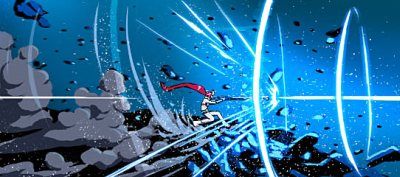
This much is true–Gurren Lagann, whether you like it or not, made a big splash this year. Gainax went back and tried to reinvent the giant robot genre (again) for the 21st century. I don’t know if they were successful, but I know they did paint a fun and colorful montage of the history of giant robots from their perspective.
In this retrospective I’d definitely like to talk about the fan response to Gurren Lagann, both the good and bad. But to save this post from overly-TL;DR, I think just mentioning it is enough to jog your memories about the LOL mixi controversies, the staff changes, and on the record I’d like to say I liked how episode 4 looked.
(As an aside, Gainax shows that they consistently listen to the fans and devise rapid responses. I wish I could say the same for the majority of anime corporate bodies out there.)
While I’m at it, I’d also like to mention the ending to Gurren Lagann, and I liked how it treated Nia and Simon. Why? Because life is lived by those those who hop, jump, skip and run its length to their ends, and not those who quietly tiptoes towards death. And Nia and Simon sure lived. It may disappoint but it’s honest in its own little deceptive ways, like how the epic montage of the first half of the series leads into ambiguity, a losing-and-finding of purpose for men who only knew how to fight and love, or why this is redemptive for them even if only hardship and heartache await at the end of it all.
Along the same lines, I’d also like to mention how Gurren Lagann is glowing with a really artificial notion of manliness. I mean if I watch old samurai films, the societal norm of manliness is a much more subtle and tempered concept than this “ROW ROW FIGHT DA POWAH” nonsense, and yet both take that realistic approach towards the fate of a swordsman who outlived his purpose. There’s a beautiful parallel here that I’m not sure if anyone drew–just like the samurai went the way of the past after the modernization of Japan in the Meiji era. I guess, so are childhood dreams that vanishes with adulthood. Fighting robot fantasies have little space in an adult world. People like Simon are not this world would like you to be, this day and age, they are rugged, uncouth, drunk, or act like a loser.
Lastly, right, the music. I like the rap tie-in, if just for the exploitative effect and tension between the background orchestra with the foreground dialog within the show. I find it fun (and slightly annoying) that how the soundtrack is mixed like an OST but the vocal tracks sticks out like sore thumbs if I make my own mix, requiring some normalization. Still, Taku Iwasaki worked his magic with his usual competent instrumentation and orchestration. And it’s rather diverse stylistically as well. An epic-spanning sense of sound garnishes an equally large work.
If we can ignore the image album crap (as I’ve been making a habit of doing, no thanks to the barrage of Kyoani anime-related products), Gurren Lagann’s only fault was not making all of its sounds available to buy. But that’s one fault not uncommon and one I can sort of forget, because the handful of tracks that memorializes this show for me personally was on the Best Sounds CD.
With all that said and done, there are probably quite a few runner up soundtracks I could mention (and should mention). A starting place is j1m0ne’s top 3 soundtrack for 2007. For example I’d make more nods to Asatte no Houkou if it was actually a 2007 show, but it’s still a great soundtrack. There are many more to mention that it’d be a blog post all on its own, so you ought to go find others to read instead ;)
This post is the fifth in a series of posts, to highlight my most memorable and remarkable moments in 2007. Or just soundtracks sometimes. If I wasn’t musically illiterate (well, sort of) and can read (Japanese) I would probably do an anison blog. I cannot get tired talking about it.

- Introduction
- Part 1 - Makoto Shinkai
- Part 2 - Baccano!
- Part 3 - Sola
- Part 4 - Hitohira
- Part 5 - Gurren Lagann
- Part 6 - Code Geass
- Part 7 - ef, Hidamari Sketch, Sayonara Zetsubo Sensei
- Part 8 - Manabi Straight
- Conclusion
ROW ROW FIGHT DA POWAH
A nice rap song for a nice clock show. No matter if you liked or disliked Gurren Lagann, in whole or in part, its a show that has a deep message. It inspires, but it also breaks people’s hearts. That’s the power.
It doesn’t help that I’ve been in a “fight the power” mood lately either.
But a English-language rap song for a clock show? Heck, that’s gotta do more for the English-language literacy rate for Japan than any other anime out there right now.
GG Taku Iwasaki. I hope you get my share of monies spent on this little album set. It’s big and proud but also finely sliced like gourmet sashimi. Yummie! Oh by the way I’ll promptly discard the DVD and other CD that may come with it…merf.
On This Rock, Kamina Builds His Church
Simon from Gurren Lagann shares similarities with Simon Peter of the Way. YA RLY.
You can read about Saint Peter here. Shimon indeed.
So it’s not a surprise that on this rock (does the term Cathedral Terra make sense to you now?) Simon builds Kamina’s church? But before people jump to conclusion about Jesus, let’s talk about Simon Peter some more.
For many scholars Peter is one of the most interesting disciples Jesus had out of the original 12. Some of them consider Peter being the spokesperson for the 12, and at least in the New Testament he was a leader of the early Church. We see him most notably when he gave the sermon at Pentecost with the baptism of the three thousand.
But he was not that sort of a man as we could possibly imagine with the brand of Christianity as you and I experience today. Much like Gureen Lagann’s Simon, Peter fished and lived humbly as a fisherman off the Sea of Galilee. He was a little rush-headed and oddly shy at times. Unlike Simon he wasn’t really a great fisher either (as Simon was a driller). But like Simon, Peter had a brother who told him of the good news.
In contrast, Gurren Lagann’s Simon isn’t likely one who would jump to cut the ear off someone; decidedly he was much matured after 7 years since he parted with Kamina. The transformation is also seen with Simon Peter from his moment of denial with the reconfirmation with Christ after the resurrection.
Am I stepping out a little too far with this bit of analogy? Maybe, but far from it be Gainax’s bag of tricks to pull punches from Christian lore. There are quite a few of the superficialities that make sense once you connect the dots. Much of the Gurren-dan can be paralleled with Jesus’ disciples. The transformation of Kamina City under Rossiu’s rule and his eventual redemption may be a little bit out there, but talking with the evangelicals today that might resound a little louder with them.
But is Kamina Jesus? I don’t think I’ll go that far, especially because there are just too many key dissimilarities. But his death was much less meaningful than his resurrection, even if only in spirit.