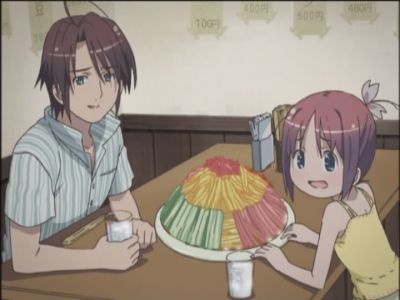
Mugi-Choco’s Cream Filling
Or, No Wait, I Mean Message, Yeah That’s It.
I think I’m finally hooked on Japanese-style text-only 2ch-style Shift_JIS UI-Gothic what-the images. Damn you Saimoe, damn you to hell! It’s like 1994 all over again.
But jokes aside, I think now it’s a good time to talk about Mugi Asai and Hitohira. It’s particularly insightful once pinned next to Manabi Straight. Because, you know, I wuuubs Manabi Straight.
To cut to the chase, Mugi Asai, the main character in Hitohira, experienced a transformation from a shy, introverted person to someone who has gotten over herself, with the help of someone else who was in her place a year before. Within the span of a school year, she bonded with this sempai and, well, drama happens. It’s a nice little piece of 12-episode anime that elaborates on Mika’s dilemma from the last 2 episodes of Manabi Straight.
But I watched Manabi Straight before Hitohira, and I suspect if you had your experience flipped chronologically, it may be just the same, with some words flipped. Which, after all, explains why Hitohira (which means petal) is the image I picked for this blog post (well–it sort of looks like 5 petals of a cherry blossom). And why it’s there to be picked as an eyecatch from the actual show, as a reasonable guess.
With her latest victory from Saimoe, it seemed that a lot of people got good vibes from her. And I can see why. Definitely a highly-recommend for those of you who can withstand high school drama in its finest amateur moment.
Convention of the γΎγ£γγ GO!! Generation
Next time I blog I’ll be in Baltimore attending Otakon. The Baltimore Convention Center does not have free wifi despite a city-wide initiative. However, some of the surrounding areas do. In any event I will blog from the hotel room at the very minimum.
I pray that the mid-summer Baltimore weather will beat upon us no worse than that is necessary, and I can find time both to relax and to be excited about life, universe, and everything. It’s not just to celebrate anime with friends and share a good time, but in a conscious way to deepen my relationship with God in a familiar but shockingly strange environment, in preparation for the thing that have yet to come.
As the “straight ahead-Go” generation that we are, I think that anime fans are some of the best types that 21st century geekdom has to offer. In some ways this means that some external forces may take advantage of us more so and we’ll cause problems with our straightforward mannerisms, but on the flip side it also shows some degree of tenacity that the long-time fans possess. In any case, rain or shine, we will be there and entertaining our favorite guests at this anime convention. If you are going, I pray that you too will do it share this enthusiasm at this mutual geeking-out.
Manabi Strikes Back
Unfulfilled, overbearing desire breeds moments of idiocy. But sometimes, it can be confused with the muffled cries of the Muse, opening doors you were too afraid to open for one reason or another.
This post has turned from vision to creation. Hosanna (work in progress preview, 39.5mb Xvid). My first AMV EVAR zomg.
Manabi Straight Banzai!
Cherry Blossoms United
This is just a list of really neat things that I’m putting together (with help from many others; you know who you are) that makes Manabi Straight’s ending such an awesome experience. It’s proudly a contender for my Best Ending Evar.
Needless to say, SPOILERS. But such good, warm, fuzzy spoilers.
- Loli’s in a Mini.
- The realization that the outfits they wore in the OP are the same as the ones in Mikan’s return, and Mikan’s outfit was the same with her outfit in her dream from episode 7. Plus that the OP actually took place in the show’s continuum!
- The most awesome and meaningful Victory Pose.
- The guitar riffing with Mikan’s feet.
- The guitar riffing + special ED + what happened to everyone afterwards
- Momoha’s publication.
- A Happy Life.
- Mucchi and Mei fussing in traffic on the way to the airport.
- The scene on board the train; not just Mikan’s tearful reprise, but how it answers the question implied in episode 1.
- Manabi’s hovercraft.
- “Sempai” talk.
- The allegory of a cherry flower in bloom (see picture below–configured like a cherry flower), how in episode 11 (which is where that picture comes from) was the blooming, and episode 12 they part (in which you see plenty of fallen blossom) like cherry blossom in season (see episode title).
- It’s still extremely cute.
- A lot of Momoha lines.
- Merorin Q!
- Completing the humanist message.
- Mei and Takako in the credit roll.
- Tagging up their alma mater.
- Resolving Mika’s dream in episode 7.
- :3
- The sweet sorrow of parting.
- The clapping.
- “Do you enjoy your happy life?”
Damn you Funimation, better get on with it!
Feel free to add your own to this list in the comments or anywhere!
Exam Hell - Examining a Perspective Bias
One common element shared by far majority of TV anime is the high school setting. Many of us who watch anime regularly may have long since gotten used to this subtle background fact of life.
Invariably a lot of the material used to make anime are aimed for the adolescent crowd, so high schools are popular settings by extension. But what is high school life like for a Japanese kid? I have no first-person experience, so I can’t say. I imagine for the lot of the non-Asian viewers, that will be the case.
Even if the Japanese education system is a bit of a hybrid between East and West, the focus on entrance exams has long twisted the Japanese education system, on practical grounds, as a means of a guide to some sort of standard of education, a setting of norm. If you did well in school you would have a shot at getting into a good college, and from that a decent job opportunity. If you’re just an egghead, then you will naturally excel in academics and if you end up in academia, all the more better. If you don’t do so well in school, there’s always hard, sweat-of-the-brow work. Or, marriage and home making.
But being an exaggerated means of escapism, anime and manga as I observed it…well, no one likes to be reminded of their day-to-day reality, especially that one big fat exam which torments their collective, uncertain future. Sure, we all can share with living under that sort of stress to some degree, but it’s another story to experience life in a society where that’s everything.
A bit of sharing: at my cram class today the professor decided to do a bit of public service and reminded us the best way to relieve anxiety is to place the impending exam in context: that there is something more important in life than one’s career, or one’s job prospect, or what will happen to us if we fail. Gain an appreciation for life right now; we are probably more fortunate than many others. At the least, not being totally strung out on stress is likely help your exam performance.
But at the same time, this stress is appreciated. It gives you a perspective.
Utopia is where Manabi Straight takes place. It’s a world without that perspective, or I should say, it actually realizes a set of fears many people in Japan should have: that when people graduate, they won’t have jobs; when people graduate, they’ll find themselves holding a depreciated piece of paper because everyone has one; when people graduate, they’ll do the same things people who are younger are doing a better job with, thanks to the future curve; when people graduate, they won’t find a more fulfilling life than before they graduate.
So what does schooling offer them? Why are we spending time milling away when we could be starting our careers today? Just because some people pay you more later on? Perhaps that is counter to the harsh reality of today, but the stress won’t end.
At the end of it all, I guess, the point is that anime is entertainment, but the healing nature of Manabi Straight comes across as the background theme behind all the commotion that we talk about. It’s a calculated effort; a show for freeters and salarymen and just those people struggling with their grinds from one period of their life to the next.