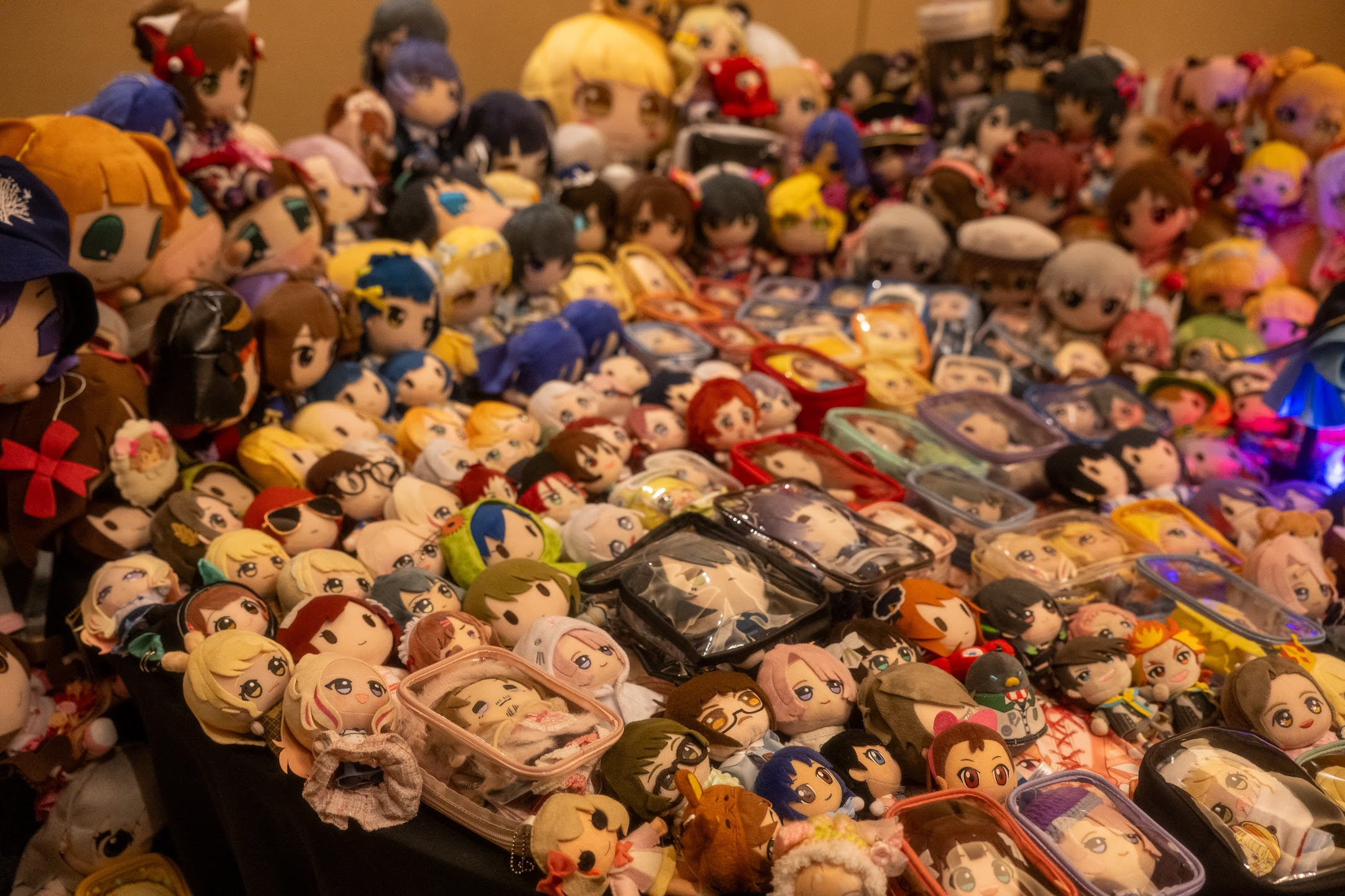
THE IDOLM@STER properly had an event in America, at Anime Central 2026. I have read a bunch people’s reactions and reflection of their trip to the con and I think I don’t have much that I could add. I am too tired to link to all of them, but I’ll try to do some at the end of this post.
The 765PRO ALLSTARS+ put on a show in August 2025, for the first time in a long time, with the full cast. You can check out the set lists here.
I was asked to give some words about Never End Idol to Vini so he can put it in a video, which I will link back here when it’s ready to go. But in order to do that, I should write some of that down and organize my thoughts.
As someone who went to it with some trepidation and anticipation, I can say that in the end all of that effort and energy was met with an equally enjoyable and memorable experience, a touchstone performance for the ages. Part of it is what I brought–a bunch of tickets so folks I met on my P journey can share the moment. Part of it is what I … brought … in that with these fan-oriented events, you get as much out of it, to some degree, as you put in. Some Ps put their entire life (or life savings, maybe) into this series, so the payback could be (the focus is on *could*) tremendous, in terms of emotional highs at least. I am not sure that was me even in 2025 terms, but I probably was in that target demographic.
For sure, it was the FOMO, I think, that made NEI worth while. It’s never going to be better than your first Yakusoku, as the logic goes. I’m glad some people got their first Yakusoku finally. Looking back at that memory after Chihaya Budokan, though, I’m not sure about that logic anymore. It’s not about logic, after all, but that’s another post.
Personally, Yakusoku is a pretty amusing thing to talk about. As someone who got into IM@S through the original TV anime and IM@S 2, you would think that meant a lot to me, but I am sure even in 2026 as I write this, it’s still just “that Chihaya song.” I thought the whole thing that went down during 9th tour was, as everyone who witnessed it, an emotional touchstone of the franchise, the moment Chihaya Ps collectively melted into Primordial Puddles of tears. But since I wasn’t there, I don’t really have a handle on it to do anything, to process that event.
Of course, as someone who didn’t go to 9th, it was tainted with a shade of FOMO. It wasn’t even really the thing I was fearing out about–I just wanted to witness in person the peak Hirorin performances during the Nagoya stop. I had more urgent things to miss out on, as it were, that I didn’t really get to think about Yakusoku or feel like I needed to fixate on how Erimingosu had added that page to their legend at the time.
Fast forward to 2025–I got to meet Erimingosu at Acen. That was the weekend when the final piece of the puzzle kind of fell into place. For the short moments I got to talk to Mingosu I was able to get a glimpse why are so many ChihayaPs are earnest tryhards, or the 10 years of history recapped in that silly ending to MOIW 2015. Of course, I had casually followed the two of them over various media forms from SNS to their IM@S and non IM@S works for decades, but I never saw the “heart” of the matter until I saw the two of them interact and each put on their cast member faces for the oversea Producers.
Anyways, the short of it is that at NEI not only I saw the same thing Erimingos saw–which are the happy crying faces of other Producers, but also I sort of better understood how it felt and what it meant. I still think the lead-in to Yakusoku on day 1 was egging it on a tad too much, and I really enjoyed the set list on day 2 more, bias or not. Across both days of NEI, things were much better for the people who were disappointed with SunrichColorful. And it is a warning that with IDOLM@STER, we are always a hair’s breadth away from disappointment–because the stakes are always so high, because the fans put so much into it.
But because for everything that I had gone through since I began this journey and for every ounce of energy and money that I spent on this series, I can see that the magic and potential for something legendary is there. It’s always riddled with risk and disappointment, but in the world of entertainment there are few opportunity for legendary experiences, and the 765PRO ALLSTARS+ are one of the few who can deliver.
And no it doesn’t even have that much to do with the great seat I got on day 2, or I got fansa from Hirorin, or that I got TEARS or VOY@GER. I see the very deep cuts NEI had (the crown thing at the end of day 1 was chef-kiss I gotta say.) but that largely missed for me. Thanks to the powers that be I was able to do some uchiage with oversea Ps after day 1. Thanks to the Hilton setup I even had a great time talking about the show and fandom in general on day 2 with Ps who stuck around in the hotel and around the venue. I even was able to chill at the 7th floor bar on day 0. The show went on and on, and it never ended for me, I suppose.
PS. Never End Idol is the first time I put decoration on my hotel window? It was fun so it’s worth doing again. Next time I’ll bring some two-sided tape…
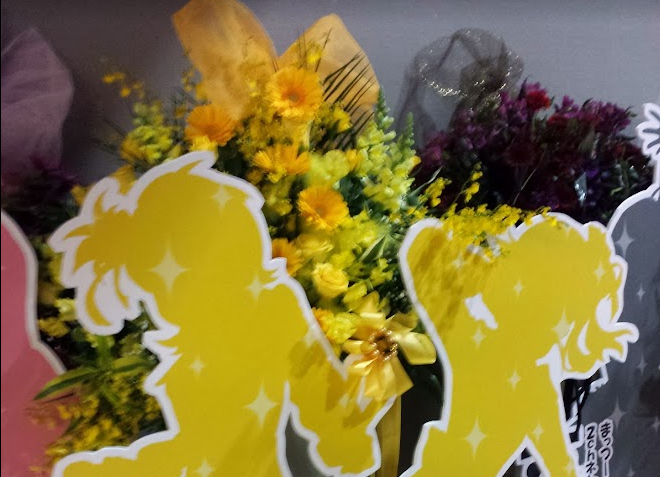
Sending a flower stand is an East Asian custom. The most amusing ones I’ve seen was when I went to Surabaya to attend a friend’s wedding. Being kind of a big deal I guess, his company, their clients, various neighborhood orgs and individuals all sent these large flower stands. Some are just your traditional-on-four-stilts type. Others are basically billboards by the side of the road made up of flowers. I mean, being Asian I saw them at weddings, funerals, store openings, and other “big” events. And in Japan, I see them at concerts.
The first time I saw otaku flower stands going to concerts was at MOIW 2014. The stands spanned across a good third of the main concourse. There were all kinds, but most notably were these similarly-formatted stands for every idol including Shacho and Kotori. Later I would learn that they were organized off 2ch. And in some ways this was peak. I think in MOIW 2015 there were literally like a kilometer worth of flower stands, and I now sort of shudder to think how much effort it was to deal with it. I guess on the other hand they were very much the full gamut of the most inexpensive to the most elaborate, but you still have to stick to the dimensions and regulations set by the event organizers. Maybe it’s a bit like an art contest, but more like an art family of love and appreciation.
I think more over the whole flower stand thing became its own thing, especially when it takes like 20 minutes to even see all the flowers by walking that kilo or more. I guess if I was doing something like hosting an IDOLM@STER concert at Seibu Dome, I can kind of wing it–there’s plenty of space, the weather was not the worst (imagine if it really poured), and at some level you kind of left it to people to fend for themselves. Japanese people are really good at self-organizing after all, and the visitors are respectful generally speaking.
But if you’re doing a show at SSA, K-Arena, or something much smaller than a stadium, you’re going to be under a lot more constraint. I can see why some shows don’t even bother with flower stands. I think everyone agree that we like these gesture of celebration to some degree, that the fans send flowers as an act of appreciation, but it’s a little too one-sided for me. This is not even mention the occasional drama that could occur from expensive fan projects, given these days the flower stands run from $500 to over $2000 even.
Actually that has been a persistent problem–most westerners who learn this cultural act actually do not know what it is like to deal with flower stands from a concert runner/promoter point of view. It’s why it will cost Anime Expo at least $500 plus union labor per hour to babysit a $500 flower stand outside Peacock Theater, so it will unlikely ever happen. It’s why you can’t just put a flower stand anywhere in the dealer room, because the fire marshal may have to OK your floor plan and which western con is going to take that into account? Or more like, even if it’s not very hard (and I don’t think it is), some guy working at a high enough level at the con has to give their 2c to make the magic happen. What magic? Maybe a photo op for the guest and some optics. I hope it’s worth the while.
[Otakon this year has a flower arrangement display near the panel room area that was roped off. It’s actually perfect for flower stands. If the right person can be reached maybe it might even work.]
I think it’s both “too much” and not enough– not many con in this country will sustainably grab guests that will have fans with enough motivation, disposable time, effort, money and skill to do it. This is why I actually prefer the Time Square ad drop, or what Bandai Namco has been working with, in terms of just actual ads in actual ad slots around town. If you’re going to throw $1000 in flowers, maybe sponsor a couple ads. You’re actually putting money into “use” and not just to flaunt at other fans attending the event. I guess flaunting is the purpose but there’s no less of that in a proper cheering ad… Just that things are much easier to deal with for the concert organizer.
I wonder how the nobori things work in comparison. Maybe it’s a push, and at least Bannam pockets the money that florists would otherwise get.
If you got too much money hosting flower stands because whatever you were doing was a popular IP and foreigners don’t have an easy way to run their own stands, maybe do what 2ch did back in the day and just play the middleman? I think it would be pretty neat.
Anyways, let me just end on this golden rule/warning. It would certainly be folly to spend too much on flowers that you can’t spend on other normal things. Flower stands are extra…nobody needs them, in a very literal sense. And when extra things cause strife, it’s what I call a self-own. The goal of these concerts is to have a good time, to shower your appreciation to the cast members or artists or whoever. Please remember the staff that run the shows also! Things like ads and even a letter to the person you like in the present box will speak just as much as having your name scribbled on a little piece of a flower stand in a sea of plants, if not more so.
PS. As I write this, the news about Aki Toyosaki’s husband just got out and I feel so bad about it. The grieving can have all my condolences.
I went to Anime Expo this year to participate mostly in the exact same things Anime Expo always offered: top lineup of seiyuu presenters at their industry anime stages, one good anisong concert, and midnight mahjong. On the side, we all know this is my one con to see Rinahamu and eat at Yard House. Also, there are international IM@S Producers gathering every time for some reason.
I said “always” but we know this is all just recent history. A couple years ago, it would take a whole village to camp for some Guest Of Honor autograph, literally, because that’s how those Funko Pop rings worked. This year it only took me a minute to reverse-engineer the wrong URL AX used to list Peach-Pit, in the comfort of my office chair. I really don’t know what to say other than, maybe this is the real lasting legacy of Anime Expo–that it screws fans, industry and staff alike, out of just near-competence and bad luck.
Of course credit is still due where it is due–I had a blast at Anime Expo this year, they made strides to improve the con. Outsourcing their autograph thing to Epic (or now part of Leap, like Growtix) may have made some things weird (I hear you Bannam) like other changes, but it’s a net positive overall. Everything on site worked smoothly once you figure out what is happening as it is new to me. The new layout of the JW ballrooms is new to me but we figured it out quickly. There are fewer volunteer staffs than ever, for better or worse, which means everyone is somewhat more rehearsed but also gaps of comms did exist in the few places I had to communicate with the hired hands at the con. For the most part the crowding is managed this year other than the day one linecon to get in.
This year they blocked off even more areas outside on the streets, and there were basically 3 or so food court/beer garden areas that are separated. At least two of them also have a stage. I wonder how much it would take for AX to put some anikura up on stage instead of random karaoke or whatever. I think once the sun sets outdoor grassland activity can be a real nice fit. Adding the Peacock theater for AX’s largest stages is also a great move I think. It still capped from a couple events, which is impressive.
I also think the attendance sort of flattened a bit from last year. There should be more people at the con this year than the last, based on my cursory observation, but it’s hard to see the masses all at once because AX has fully spread out all over LACC and LA Live. It was hard to actually canvas the entire con just due to the crowding at certain time/points and the sheer large area you have to go through.
The dealers were even more distributed between the South Hall (Exhibition Hall), West Hall (Entertainment Hall), and Kentia Hall (Artist Alley). I saw booths selling fanart in the Exhibition Hall. Usual suspect Retro Saikou is out in the Entertainment Hall along with all the Chinese mobile game booth hells. Everything is kind of scrambled. Also TIL Intel was sponsoring a glow-up experience at one of the PC gaming brands. Times have changed.
As per usual, AX this year had a lot of random stuff happening. We were half expecting a surprise Mariya Ise to show up at Panty Stocking S2’s premiere, but I didn’t think it happened? Instead we got surprise Asami Seto-chan at the Apothecary panel with the ever-not-AX-size Yuki Aoi. The seiyuu list is pretty star-studded this year compared to even the last, given how many more of them are here. I think I finally got to see Suguta close up this year, and also, lol, Sora Amamiya? Her famous cheeks made their Continental US debut at an event.
I somehow was not able to see Isobe or Shimayuki, probably because of conflicts, which is kind of unthinkable 5 years ago. Carin Isobe at AX and I didn’t go see her? LOL. Anyways, lots of people enjoyed the two of them who were dishing out fan service during the Proseka panel, or so it seemed.
I attended the Gakumas 1st concerts this weekend. It’s called “1st Period” but it’s actually not the first concert for the media-mix mobile game franchise. It’s just the first show (or 4 shows, spanning 2 weekends) that features the full cast, after the roughly-dated anniversary of the game’s live service a year ago. Since the game (and really before the game was released, including all the lead-up marketing) became available it has done well in the rankings and players generally have good things to say about the latest entry in the IDOLM@STER series. A lot was on the shoulders of the staff and cast to make this hotly-anticipated show a success.
There was a set of tours where 3 cast members form a team and tour Japan’s 3 largest cities (Tokyo, Osaka, Nagoya), each team doing 3 stops within a month, in almost back-to-back months. One of the stops was postponed by a typhoon, while the last set of 3 had a gap until February of this year. The appropriately called “Hajime” Tour needs to be mentioned because this is the cast’s actual first live stage experience, except one member. The tour definitely gave the stage experience to many of the newbies in the Gakumas cast, and more importantly it gave the fans a glimpse of what fresh grasshoppers were like close to a year ago.
The importance (or however little it is) put on seeing the growth of the idols is a core tenant in the design of the game, which various interviews have listed. This is just another aspect I suppose, but I appreciate how they made the live performance aspect parallel to its digital version. Or rather, I appreciate them knowing what it ought to be like on the receiving end.
As a Million P for many years, it feels tortured, it basically feels the opposite of it–things we would love and be hyped about often don’t happen when they ought to, or happens at all. Some things are delayed by over 10 years. Maybe delay is the wrong word, but at some point it just became sort of this deep barrel or well where we are glad to have anything being pulled out of, even though we know the contents can make for something much more.
Anyways, for a good example, when Our Chant dropped on Day Two of Harmony Star, we know (since the SSR) there would be a flag just like how Chiisana Yabou, Wonder Scale and Clumsy Trick all had their props. So Gakumas surprised and delighted us by adding Saki to the picture when she walks in with the flag. In fact, after seeing the Hajime Tour version of Wonder Scale and Chiisana Yabou we already think there would be props, just like how the game versions did. For even more foreshadowing, Harmony Star featured a duet (or trio in one case) of cast members joining in another idol’s solo song (and for this weekend it was limited to the B-side solos) so by the point on the second day when Our Chant happened, it felt like a perfect match when you stick the right jigsaw puzzle piece in the right slot.
For details, here are the links to the official site posts for the show, for posterity, and the usual imas-dblinks. Onward with the rest.